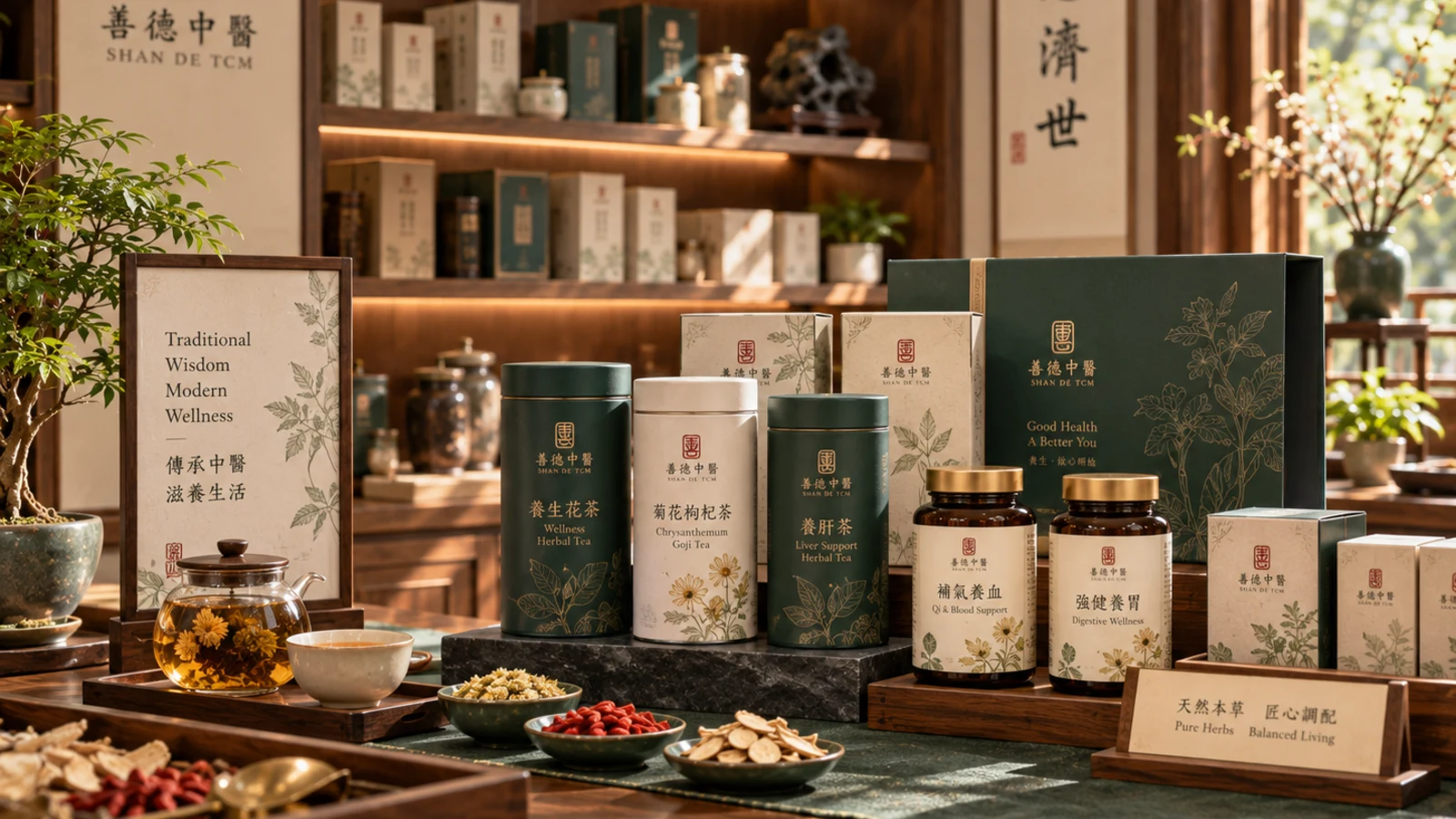
The meaning behind 善德中医堂
Yang Yang explains the clinic name through three ideas. “善” reflects the teaching to do good in everyday life. “德” is connected to her Dharma name and serves as a reminder to act with integrity, stay grounded and put people first. “中医堂” reflects her respect for Traditional Chinese Medicine as a body of knowledge and cultural heritage to be passed on responsibly.
Medical heritage from an early age
Yang Yang grew up in a medical family. Her grandfather used locally gathered herbs for external applications and cared for people in the community, while other family members later entered kidney medicine, dentistry and orthopaedics in China. She remembers his teaching clearly: medical ethics come first, people come first, and a practitioner should neither exaggerate nor become arrogant.
Her earliest TCM teacher was her uncle. From around the age of eight she observed and helped with traditional herbal practice in a rural town, learning how prescriptions and decoctions were prepared and how long some herbs needed to be cooked.
From hospital work in China to practice in Singapore
After graduation, Yang Yang worked at a private hospital in Shandong, mainly in an obstetrics-and-gynaecology setting involving both Chinese and Western medical care. After coming to Singapore, she continued studying while working and volunteering, and became especially interested in the everyday mobility, joint, neck and shoulder concerns she encountered among older adults and office workers.
Shande Traditional Chinese Medicine has operated at Fortune Centre since 2018. Yang Yang describes approximately 20 years of TCM-related experience, including around 14 years of practice experience in Singapore.
Continuing study and a practical treatment philosophy
Yang Yang has continued studying across TCM, manual and physical therapy, psychology and related areas. Her learning journey includes further TCM study in Singapore, a physical/manual therapy certificate, psychology diploma studies, further study at The Chinese University of Hong Kong in 2025 and ongoing postgraduate study in 2026. Additional qualification details will only be published when the supporting documents and exact programme names are available.
Her guiding principle is to assess carefully, identify the main pattern and problem, explain it clearly, and then discuss an appropriate plan. The clinic may combine traditional approaches such as moxibustion and external herbal applications with selected physical modalities when suitable. No treatment is presented as appropriate for everyone, and conventional medical review is recommended when needed.
Clinical concerns Yang Yang commonly discusses
In day-to-day practice, Yang Yang commonly speaks with people about persistent joint and mobility discomfort, overuse-related elbow pain such as tennis elbow, heel pain, and questions arising after a medical diagnosis of osteoarthritis, rheumatic disease, joint swelling or effusion, elevated uric acid or gout. Rhinitis and recurring nasal discomfort are also frequent reasons for enquiry.
Some people also ask about dry eyes, visual strain or blurred vision. These symptoms are approached cautiously: persistent or worsening blurred vision, declining vision, eye pain or redness, sudden visual change, or suspected cataract should be assessed by an appropriate eye-care professional. Shande does not present TCM as a replacement for ophthalmic diagnosis or treatment.
Within TCM, terms such as “dampness” are used as traditional pattern descriptions rather than biomedical diagnoses. Any TCM plan is discussed in the context of the individual’s symptoms, medical history, medicines and safety needs.